Understand IGNOU and NIOS: School Board vs University, Courses, Fees and Exams
IGNOU vs NIOS: what each one is and how they differ
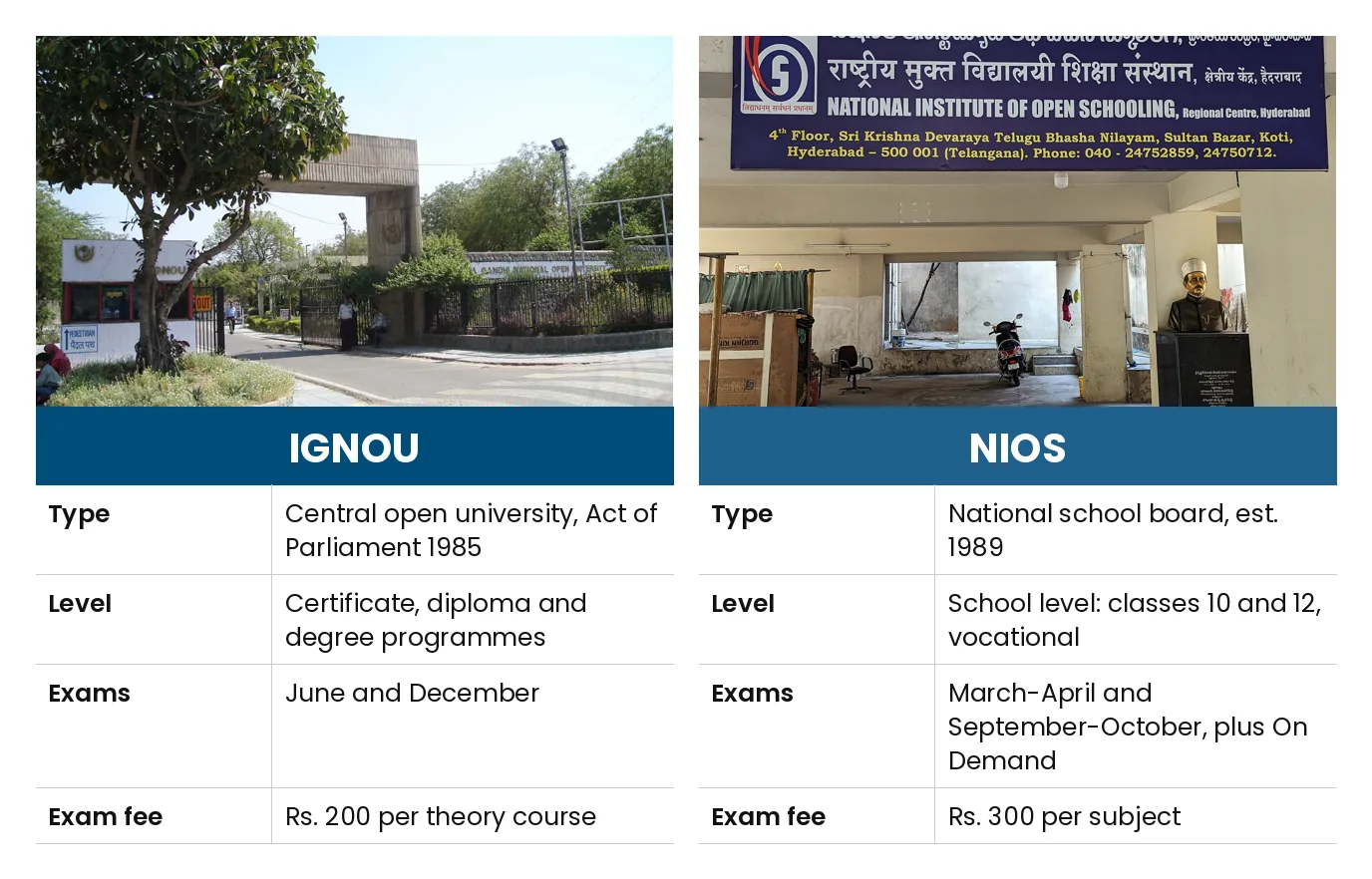
IGNOU is a national open university, while NIOS is a national board of school education. IGNOU was established in 1985 by an Act of Parliament, the IGNOU Act, 1985. NIOS, initially the National Open School, was established in 1989 as an autonomous institution under the Ministry of Education, Government of India.
IGNOU offers programmes through both Open and Distance Learning (ODL) and Online modes. It began in 1987 with two programmes and an intake of 4,528 students. The university operates with 21 Schools of Studies.
NIOS provides school education up to the pre-degree level, including equivalents for classes 3, 5, 8, 10, and 12, as well as vocational courses. It is a school board and awards certificates, not degrees. NIOS states that it is one of the three National Boards of School Education, alongside CBSE and CISCE.
NIOS delivers its education solely through the Open and Distance Learning (ODL) mode. In the 2024-25 session, over 5.04 lakh learners were admitted. The institution’s headquarters are in NOIDA, Uttar Pradesh, while IGNOU’s headquarters are in New Delhi.
| Point | IGNOU | NIOS |
|---|---|---|
| Institution type | National Open University established by an Act of Parliament (central open university) | Autonomous institution under the Ministry of Education, Government of India; a national board of school education |
| Parent Act or body | IGNOU Act, 1985 (Act No. 50 of 1985) | National Open School Society, an autonomous registered body set up by the Government of India on 23 November 1989; exam and certification authority vested by MHRD Resolution of 14 September 1990 |
| Year established | 1985 | 1989, as the National Open School |
| Headquarters location | New Delhi (Maidan Garhi, New Delhi-110068) | A-24/25, Institutional Area, Sector 62, NOIDA, Uttar Pradesh 201309 |
| Modes of delivery | Programmes are offered through Open and Distance Learning (ODL) and Online modes | Open and Distance Learning (ODL) only; the other two national boards teach face to face |
IGNOU only
- UGC-DEB classification: Central Open University, Delhi
- First programmes and intake: Began in 1987 with two programmes (Diploma in Management, Diploma in Distance Education) and 4,528 students
- Schools of Studies: 21 Schools of Studies
- Change of elective/course: Allowed within 30 days of receiving the first set of course material, on payment of a fee
NIOS only
- Origin and renaming: Grew out of the CBSE Open School project started in 1979; called National Open School till 2002, then renamed NIOS
- Education level provided: School education up to pre-degree level (classes 3/5/8 equivalents, class 10, class 12 and vocational courses). NIOS is a school board, not a university; it awards certificates, not degrees.
- Peer boards: NIOS, CBSE and CISCE are the three National Boards of School Education
- Size and enrollment: Cumulative enrolment 23.52 lakh over the last 5 years; over 5.04 lakh admitted in 2024-25; More than 5.04 lakh learners (2024-25)
IGNOU vs NIOS recognition and validity
IGNOU is a university that awards degrees, diplomas, and certificates, while NIOS is a school board that issues secondary and senior secondary certificates. Both institutions hold official recognition from various bodies in India.
IGNOU holds an A++ NAAC grade and is ranked as the No. 1 Open University in the NIRF 2024 and 2025 rankings. Its programmes are considered at par with those approved by the UGC-Distance Education Bureau. The UGC (ODL Programmes and Online Programmes) Regulations do not apply to IGNOU. The university’s ODL programmes are listed on the UGC-DEB “Know your Program” list for the 2026-27 July session, with 125 ODL and 16 Online rows counted. Degrees, diplomas, and certificates from IGNOU are recognised by all member institutions of the Association of Indian Universities (AIU). The AICTE recognises IGNOU’s MBA and MCA programmes from 2022-23 to 2026-27. The UGC states that UG/PG degrees and PG diplomas obtained through ODL or Online mode are equivalent to conventional-mode awards.
NIOS is authorised by a Government of India Resolution dated 14 September 1990 to register, examine, and certify up to the pre-degree level. NIOS states that its Secondary and Senior Secondary certificates are equivalent to those from any other Board of School Education, as all boards follow the NCERT National Curriculum Framework. These certificates are recognised for higher education, government jobs, and other purposes. The AIU granted equivalence for NIOS courses with other recognised boards for admission to higher studies at Indian universities in a letter dated 25 July 1991. An AICTE circular dated 29 September 2025 states that NIOS is recognised at par with CBSE, CISCE, and State Boards for the 2025 session. AICTE-approved institutions are directed to treat NIOS pass-outs equally for admission. The Medical Council of India decided in 2012 that NIOS 10+2 students may be eligible for MBBS admission if they meet the Graduate Medical Education eligibility criteria. NIOS is also recognised by NCVET as an Awarding Body for Assessment and Certification (Dual Category). NIOS states that its alumni study at IITs, Delhi University, and Jamia Millia Islamia.
| Point | IGNOU | NIOS |
|---|---|---|
| AIU recognition of awards | Degrees, diplomas and certificates recognised by all member institutions of the Association of Indian Universities Recognised by all AIU member universities; at par with degrees/diplomas/certificates of all Indian universities |
AIU granted equivalence of NOS courses with other recognised boards for admission to higher studies at Indian universities |
| AICTE approval | AICTE recognition of MBA and MCA from 2022-23 to 2026-27 | AICTE states NIOS is recognised at par with CBSE, CISCE and State Boards (2025) AICTE-approved institutions directed to treat NIOS pass-outs at par with other recognised boards for admission |
| Equivalence of degrees | UGC regulation quoted by IGNOU: UG/PG degrees and PG diplomas through ODL or Online mode are treated as equivalent to conventional-mode awards | Stated as equivalent to certificates of any other Board of School Education All boards follow the NCERT National Curriculum Framework, so certificates are at par |
IGNOU only
- NAAC grade: A++
- NIRF ranking: No. 1 among Open Universities in NIRF 2024 and 2025
- UGC ODL regulations: IGNOU is exempted from the UGC (ODL Programmes and Online Programmes) Regulations
- UGC-DEB programme status: IGNOU programmes are at par with programmes approved by the UGC-Distance Education Bureau; IGNOU ODL programmes are listed on the UGC-DEB "Know your Program" list for 2026-27, July session (125 ODL rows and 16 Online rows counted for 2026-27)
- Certificates through DigiLocker: Degree, diploma and certificate are available through DigiLocker
NIOS only
- Authority to certify: Vested by Government of India Resolution dated 14 September 1990 (Gazette 20 October 1990) to register, examine and certify up to pre-degree level
- Validity of certificates: Recognised for higher education, Government jobs and all other purposes (as stated by NIOS)
- Medical Council of India: NIOS 10+2 students may be considered eligible for MBBS admission if they meet the Graduate Medical Education eligibility criteria
- OBE recognition: Government of India letter of 11 December 2002 accords recognition to NIOS primary and middle level examinations
- NCVET status: Recognised by NCVET as an Awarding Body for Assessment and Certification (Dual Category)
- Eligibility for higher education: Admission to higher education (universities, engineering colleges, professional institutions) on the same footing as other class 12 boards, subject to each institution's own eligibility rules; IITs, Delhi University, Jamia Hamdard, Jamia Millia Islamia, AMU and others
- Subject combination caution: Universities/boards may require specific subject combinations; learner must choose subjects accordingly
- Two-year gap rule: A gap of two years from the year of passing Secondary is required to obtain the Senior Secondary certificate; without it only 4 subjects can be taken in an exam
- Documents on passing: Marks Statement-cum-Certificate and Migration-cum-Transfer Certificate, only for overall pass learners, sent via Regional Centre
More on the IGNOU degree: whether an IGNOU degree is valid and IGNOU degree certificate, migration and convocation.
IGNOU vs NIOS eligibility: who can enrol
IGNOU and NIOS serve different educational levels. IGNOU is a university, while NIOS is a school board. This means that NIOS qualifications can lead to eligibility for IGNOU programmes.
IGNOU states that it is open to all, with no age or region bar. It has a pan-India reach and 25 Overseas Study Centres in 15 countries. Foreign students residing in India are eligible for selected programmes if they hold a valid student visa for the minimum duration of the programme. A student may pursue two academic programmes simultaneously through ODL / Online mode, with conditions applying.
NIOS publishes specific age criteria for enrolment. For Secondary courses, the minimum age is 14 years, and for Senior Secondary, it is 15 years; there is no upper age limit. The minimum qualification for Secondary is Class VIII pass or a self-certificate, along with being 14 years of age. For Senior Secondary, a Secondary (Class 10) pass from a recognised Board is required. NIOS operates across India and abroad, with study centres in India, Nepal, and Middle East countries. Vocational courses have a minimum age of 14 for Secondary level and 15 for Senior Secondary level, with some exceptions.
| Point | IGNOU | NIOS |
|---|---|---|
| Age and region access | Access for all irrespective of age, region, religion and gender | Minimum 14 years for Secondary, 15 years for Senior Secondary; no upper age limit |
| Geographic reach | Pan-India, plus 25 Overseas Study Centres in 15 countries | All India and abroad; study centres in India, Nepal and Middle East countries |
IGNOU only
- Foreign student eligibility: Eligible for selected programmes if they hold a valid student visa for the minimum duration of the programme
- Simultaneous programmes: A student may pursue two academic programmes simultaneously through ODL / Online mode (conditions apply)
NIOS only
- Secondary age cut-off: 14 years as on 31 July 2026; 14 years, born on or before 31/01/2013
- Senior Secondary age cut-off: 15 years as on 31 July 2026
- Secondary minimum qualification: Class VIII pass, or a self certificate; 14 years of age
- Senior Secondary minimum qualification: Secondary (class 10) pass from a recognised Board
- Vocational minimum age: 14 for courses up to Secondary level, 15 up to Senior Secondary level (16/18 for some); 11 where entry level is literate/5th class
IGNOU entry rules: IGNOU eligibility criteria and IGNOU at a glance.
IGNOU student services
IGNOU vs NIOS courses offered
IGNOU and NIOS offer different levels of education. IGNOU provides university-level awards, including Certificates, Diplomas, Advanced Diplomas, Post Graduate Diplomas, and Degrees. NIOS, focuses on school-level education, offering Open Basic Education (OBE) equivalent to classes III, V, and VIII, along with Secondary (Class X) and Senior Secondary (Class XII) courses.
IGNOU publishes a total of 325 programmes.
NIOS offers around 54 vocational courses along with its academic streams. The Secondary Course (Class X), Stream 1, has a total fee of Rs. 2,340 for five subjects for general male candidates. The Senior Secondary Course (Class XII), Stream 1, costs Rs. 2,600 for five subjects for general male candidates. NIOS also supports credit transfer for ITI students to earn Secondary or Senior Secondary certificates.
IGNOU only
- Award levels: Certificates, Diplomas, Advance Diplomas, Post Graduate Diplomas and Degrees
- General Bachelor of Arts: Bachelor of Arts (BAM), a multidisciplinary 3-year degree under the FYUP framework
- Credits for -year bachelor: 120 credits in a minimum of six semesters (three years)
- Four-year UG programmes: Exit after 3 years (120 credits) gives a Degree with Major; 4 years (160 credits) gives a Degree with Honours
- Multiple entry and exit: Multiple Entry and Multiple Exit Scheme applies to FYUP undergraduate programmes from the July 2025 admission session
- CBCS BA Honours credits: BA (Honours) under CBCS: 148 credits in a minimum of six semesters (three years)
- Continuing learner exams: BAG and BCOMG appear in the programme-code list of the December 2026 term-end date sheet (December 2026 TEE)
- Diploma in Early Childhood: Diploma in Early Childhood Care and Education (DECE): 10+2 or equivalent; 1 to 3 years; Rs. 4,000 (July 2026)
- Diploma in Nutrition: Diploma in Nutrition & Health Education (DNHE): 10+2 or equivalent; 1 to 3 years; Rs. 4,000 (July 2026)
- Certificate in Environmental Studies: Certificate in Environmental Studies (CES): 10+2 or equivalent; 6 months to 2 years; Rs. 2,900 (July 2026)
- Degree entry requirement: BCA_NEW: 10+2 or its equivalent, or a pass in Diploma in Commercial Practice or equivalent (see the programmes list for the other degrees, all 10+2)
- Certificate in Information Technology: 10th pass; 6 months to 2 years; Rs. 6,200
- Certificate in Water Harvesting: 10th pass; 6 months to 2 years; Rs. 2,900
- Certificate in Home Based Health Care: 10th pass (Matriculation); 6 months to 2 years; Rs. 2,900
- Certificate in Energy Technology: 10th pass; 6 months to 2 years; Rs. 3,200
- Certificate in Food and Nutrition: No formal qualification, minimum age 18; 6 months to 2 years; Rs. 2,600
NIOS only
- Open Basic Education: Levels A, B and C, equivalent to classes III, V and VIII
- Subjects for pass certificate: Minimum 5 subjects (1 or 2 languages plus 3 or 4 others)
- Maximum subjects: Up to 2 additional subjects; maximum 7
- Mediums at Secondary: Hindi, English, Urdu, Marathi, Telugu, Gujarati, Malayalam, Tamil, Odia, Punjabi, Assamese, Sanskrit, Kannada
- Mediums at Senior Secondary: Hindi, English, Urdu, Bengali, Gujarati, Sanskrit, Odia
- D.El.Ed programme: Described on nios.ac.in as a package for in-service untrained teachers; the page carries study material links only
- ITI credit transfer: ITI students can earn an NIOS Secondary/Senior Secondary certificate via credit transfer under an MoU with DGT
What IGNOU offers
| Programme | Level | Fee | Eligibility |
|---|---|---|---|
| Bachelor of Arts (Multidisciplinary) | UG | Rs. 5,000 per year (July 2026) | 10+2 or its equivalent |
| Bachelor of Commerce (Major / FYUP Honours) | UG | Rs. 5,000 per year (July 2026) | 10+2 or its equivalent |
| Bachelor of Arts (English) (Major / FYUP Honours) | UG | Rs. 5,500 per year (July 2026) | 10+2 or its equivalent |
| Bachelor of Arts (Political Science) (Major / FYUP Honours) | UG | Rs. 5,500 per year (July 2026) | 10+2 or its equivalent |
| Bachelor of Arts English (Honours) (CBCS, 3-year) | UG | Rs. 5,500 per year (July 2026) | 10+2 or its equivalent |
| Bachelor of Arts (Honours) Political Science (CBCS, 3-year) | UG | Rs. 5,500 per year (July 2026) | 10+2 or its equivalent |
| Bachelor of Business Administration | UG | Rs. 10,500 per year (July 2026) | 10+2 passed or its equivalent |
| Bachelor of Business Administration (Retailing) | UG | Rs. 11,000 per year (July 2026) | 10+2 or equivalent (direct entry), or sponsored retail-organisation employees who have passed 10+2 |
| Bachelor of Business Administration (Services Management) | UG | Rs. 18,000 per year (July 2026) | 10+2 or equivalent, at least 18 years of age, and working in the services industry as a full-time intern / apprentice / employee |
| Bachelor of Computer Applications | UG | Rs. 8,300 per semester (July 2026) | 10+2 or its equivalent, or a pass in Diploma in Commercial Practice or equivalent |
| Master of Arts (English) | PG | Rs. 8,200 per year (July 2026) | Bachelor's Degree or a higher degree from a recognized University |
| Master of Arts (Hindi) | PG | Rs. 8,200 per year (July 2026) | Bachelor's Degree or a higher degree from a recognized University |
| Master of Arts (History) | PG | Rs. 8,200 per year (July 2026) | Bachelor's Degree or a higher degree from a recognized University |
| Master of Arts (Political Science) | PG | Rs. 8,200 per year (July 2026) | Bachelor's Degree or a higher degree from a recognized University |
| Master of Arts (Economics) | PG | Rs. 9,500 per year (July 2026) | Bachelor's Degree or a higher degree from a recognized University |
| Master of Commerce | PG | Rs. 10,200 per year (July 2026) | Bachelor's Degree or a higher degree from a recognized University |
| Master of Business Administration | PG | Rs. 16,000 per semester for semesters I, II and IV; Rs. 18,000 for semester III (July 2026) | Bachelor Degree of minimum 3 years duration with at least 50% marks (45% for reserved category) |
| Master of Computer Applications | PG | Rs. 13,000 per semester (July 2026) | Category 1: BCA / Bachelor Degree in Computer Science Engineering or equivalent. Category 2: B.Sc./B.Com./B.A. with Mathematics at 10+2 or graduation level (two bridge courses added) |
What NIOS offers
| Programme | Level | Fee | Eligibility |
|---|---|---|---|
| Secondary Course (Class X), Stream 1 | School: Secondary (class 10) | Rs. 2,340 for 5 subjects (General male); Rs. 1,890 (Female/Third Gender); Rs. 1,560 (SC/ST, Ex-Servicemen, PwD); Rs. 940 per additional subject; exam fee separate (2026-27) | Class VIII pass or self certificate |
| Senior Secondary Course (Class XII), Stream 1 | School: Senior Secondary (class 12) | Rs. 2,600 for 5 subjects (General male); Rs. 2,150 (Female/Third Gender); Rs. 1,690 (SC/ST, Ex-Servicemen, PwD); Rs. 940 per additional subject; exam fee separate (2026-27) | Secondary (class 10) pass from a recognised Board |
| Secondary / Senior Secondary, Stream 2 (failed or could not appear in another board; first NIOS exam Sept-Oct 2026) | School: class 10 / class 12 | Registration Rs. 620 per subject + exam fee Rs. 300 per subject (theory) + Rs. 150 per subject practical; TOC Rs. 230 per subject; different/additional subject Rs. 940 (2026-27) | Passed, failed, or was eligible but could not appear in Secondary/Senior Secondary exam of a recognised board; age and address proof as per Table 3 |
| Secondary, Stream 3 (On Demand Examination) | School: Secondary (class 10) | Registration Rs. 620 per subject + exam fee Rs. 600 per subject (theory) + Rs. 250 per subject practical; TOC Rs. 230 per subject (2026-27) | Passed, failed, or was eligible but could not appear in the Secondary exam of a recognised board |
| Senior Secondary, Stream 4 (On Demand Examination) | School: Senior Secondary (class 12) | Registration Rs. 620 per subject + exam fee Rs. 600 per subject (theory) + Rs. 250 per subject practical; TOC Rs. 230 per subject (2026-27) | Passed Senior Secondary or above, or failed / could not appear in the Senior Secondary exam of a recognised board |
| Dual Enrolment / Part Admission (Stream 1), Secondary or Senior Secondary subjects | School: class 10 / class 12 (single subjects) | Registration Rs. 620 per subject + study material Rs. 470 (Secondary) or Rs. 520 (Senior Secondary) per subject; TOC Rs. 230 per subject (2026-27) | Studying in a regular school, or already passed Secondary/Senior Secondary or higher from a recognised board |
| Open Basic Education (OBE) Level A | School: elementary, equivalent to class 3 | Processing charge Rs. 300 per learner (plus Rs. 70 per online transaction); study material not included (2026-27) | No minimum educational qualification |
| Open Basic Education (OBE) Level B | School: elementary, equivalent to class 5 | Processing charge Rs. 500 per learner (plus Rs. 70 per online transaction); study material not included (2026-27) | No minimum educational qualification |
| Open Basic Education (OBE) Level C | School: elementary, equivalent to class 8 | Processing charge Rs. 800 per learner (plus Rs. 70 per online transaction); study material not included (2026-27) | No minimum educational qualification |
| Diploma in Elementary Education (D.El.Ed) | Teacher training diploma (for in-service untrained teachers) | Not published | In-service untrained teachers working in primary/upper primary schools |
| Basic Computing | Vocational (school / pre-degree level) | Rs. 3,000 General male; Rs. 2,750 Female; Rs. 2,600 SC/ST/Ex-Servicemen/PwD (total programme fee = AVI share + NIOS share) (2026) | Literate |
| Plumbing | Vocational (school / pre-degree level) | Rs. 5,000 General male; Rs. 4,600 Female; Rs. 4,350 SC/ST/Ex-Servicemen/PwD (total programme fee = AVI share + NIOS share) (2026) | 10th pass |
| Cutting and Tailoring | Vocational (school / pre-degree level) | Rs. 2,000 General male; Rs. 1,850 Female; Rs. 1,700 SC/ST/Ex-Servicemen/PwD (total programme fee = AVI share + NIOS share) (2026) | Literate |
| Certificate in Computer Applications (CCA) | Vocational (school / pre-degree level) | Rs. 6,000 General male; Rs. 5,500 Female; Rs. 5,200 SC/ST/Ex-Servicemen/PwD (total programme fee = AVI share + NIOS share) (2026) | 10th pass |
| Certificate in Early Childhood Care and Education (ECCE) | Vocational (school / pre-degree level) | Rs. 5,000 General male; Rs. 4,600 Female; Rs. 4,300 SC/ST/Ex-Servicemen/PwD (total programme fee = AVI share + NIOS share) (2026) | 10th pass |
| Electrical Technician | Vocational (school / pre-degree level) | Rs. 8,000 General male; Rs. 7,350 Female; Rs. 6,950 SC/ST/Ex-Servicemen/PwD (total programme fee = AVI share + NIOS share) (2026) | 10th pass |
| Certificate in Library and Information Science | Vocational (school / pre-degree level) | Rs. 3,000 General male; Rs. 2,750 Female; Rs. 2,600 SC/ST/Ex-Servicemen/PwD (total programme fee = AVI share + NIOS share) (2026) | 10th pass |
| Diploma in Insurance Services | Vocational (school / pre-degree level) | Rs. 7,000 General male; Rs. 6,450 Female; Rs. 6,100 SC/ST/Ex-Servicemen/PwD (total programme fee = AVI share + NIOS share) (2026) | 12th pass |
| Diploma in Food Production Management (Cookery) | Vocational (school / pre-degree level) | Rs. 60,000 General male; Rs. 55,200 Female; Rs. 52,080 SC/ST/Ex-Servicemen/PwD (total programme fee = AVI share + NIOS share) (2026) | 10th pass |
| Catering Management (stand-alone, Senior Secondary level) | Vocational (school / pre-degree level) | Rs. 6,000 General male; Rs. 5,500 Female; Rs. 5,200 SC/ST/Ex-Servicemen/PwD (total programme fee = AVI share + NIOS share) (2026) | 10th pass |
IGNOU course guides: IGNOU BA; IGNOU MBA; IGNOU MA; IGNOU MCA and IGNOU syllabus.
IGNOU vs NIOS fees, course by course
NIOS offers school-level education, while IGNOU provides university-level degrees. The fees for NIOS Secondary (Class X) Stream 1 are Rs. 2,340 for general male learners for five subjects, while IGNOU’s Bachelor of Arts (Multidisciplinary) costs Rs. 15,000 for three years, at Rs. 5,000 per year for the July 2026 session.
NIOS Senior Secondary (Class XII) Stream 1 has a fee of Rs. 2,600 for general male learners for five subjects for the 2026-27 session. IGNOU’s Bachelor of Commerce (Major / FYUP Honours) costs Rs. 15,000 for a three-year Major exit, or Rs. 20,000 for a four-year Honours degree, at Rs. 5,000 per year for the July 2026 session. NIOS charges an examination fee separately, which is Rs. 300 per subject for theory and an additional Rs. 150 per subject for practicals for public examinations in the 2026-27 session. IGNOU also states that examination fees are separate for its programmes.
IGNOU offers a programme fee exemption for SC/ST students as per university policy for the July 2026 session. Prison inmates are also exempt from programme and registration fees. NIOS publishes lower fees for females/third gender, SC/ST, ex-servicemen, and persons with disabilities for the 2026-27 session, and offers full exemption from admission and examination fees for jail inmates. IGNOU refunds fees if an application is cancelled before admission confirmation, with a 15% deduction capped at Rs. 2,000 after confirmation, but no refund after 60 days from the closing date of admissions for the July 2026 session. NIOS states that admission and exam fees are not refunded or adjusted on any account for the 2026-27 session.
| Point | IGNOU | NIOS |
|---|---|---|
| Fee exemption for SC/ST | Programme fee exemption for SC/ST students as per University policy (policy reviewed every admission cycle) (July 2026) | Lower fee for females/third gender, and for SC/ST, ex-servicemen and persons with disabilities (2026-27) |
| Fee exemption for inmates | Prison inmates are exempt from programme fee including registration fee (July 2026) | Full exemption from admission and examination fee (2026-27) |
| Government scholarships | IGNOU learners are eligible for Government of India scholarships via the National Scholarship Portal | Dr. Ambedkar National Scholarship Scheme for meritorious SC/ST learners (one-time cash award to top three in class X) (2026-27) |
IGNOU only
- Refund before confirmation: Fee paid is refunded if the application is cancelled before confirmation of admission (July 2026)
- Refund after confirmation: 15% of the programme fee, capped at Rs. 2,000, is deducted (July 2026)
- Refund cut-off: No refund after 60 days from the closing date of admissions (July 2026)
- Extra time for disabled: Two extra years beyond the maximum duration for learners with 40% or more disability (July 2026)
NIOS only
- Refund of admission fee: No refund on any account (2026-27)
- Refund of exam fee: Not refunded or adjusted (2026-27)
- Admission fee covers: Registration, study material, PCPs, identity card, evaluation of assignments; exam fee is separate (2026-27)
- Exam fee separate: Examination fee is paid separately (2026-27)
- Public exam fee: Rs. 300 per subject; plus Rs. 150 per subject for practicals (2026-27)
- Practical exam fee: Rs. 150 per subject additional (2026-27)
- SDMIS portal exam fee: Rs. 250 theory + Rs. 120 practical for Stream 2; Rs. 500 + Rs. 200 for Streams 3/4 (not dated on page)
- On Demand exam fee: Rs. 600 per subject + Rs. 250 extra for a subject with practical (2026-27)
What IGNOU offers
| Programme | Level | Fee | Eligibility |
|---|---|---|---|
| Bachelor of Arts (Multidisciplinary) | UG | Rs. 5,000 per year (July 2026) | 10+2 or its equivalent |
| Bachelor of Commerce (Major / FYUP Honours) | UG | Rs. 5,000 per year (July 2026) | 10+2 or its equivalent |
| Bachelor of Arts (English) (Major / FYUP Honours) | UG | Rs. 5,500 per year (July 2026) | 10+2 or its equivalent |
| Bachelor of Arts (Political Science) (Major / FYUP Honours) | UG | Rs. 5,500 per year (July 2026) | 10+2 or its equivalent |
| Bachelor of Arts English (Honours) (CBCS, 3-year) | UG | Rs. 5,500 per year (July 2026) | 10+2 or its equivalent |
| Bachelor of Arts (Honours) Political Science (CBCS, 3-year) | UG | Rs. 5,500 per year (July 2026) | 10+2 or its equivalent |
| Bachelor of Business Administration | UG | Rs. 10,500 per year (July 2026) | 10+2 passed or its equivalent |
| Bachelor of Business Administration (Retailing) | UG | Rs. 11,000 per year (July 2026) | 10+2 or equivalent (direct entry), or sponsored retail-organisation employees who have passed 10+2 |
| Bachelor of Business Administration (Services Management) | UG | Rs. 18,000 per year (July 2026) | 10+2 or equivalent, at least 18 years of age, and working in the services industry as a full-time intern / apprentice / employee |
| Bachelor of Computer Applications | UG | Rs. 8,300 per semester (July 2026) | 10+2 or its equivalent, or a pass in Diploma in Commercial Practice or equivalent |
| Master of Arts (English) | PG | Rs. 8,200 per year (July 2026) | Bachelor's Degree or a higher degree from a recognized University |
| Master of Arts (Hindi) | PG | Rs. 8,200 per year (July 2026) | Bachelor's Degree or a higher degree from a recognized University |
| Master of Arts (History) | PG | Rs. 8,200 per year (July 2026) | Bachelor's Degree or a higher degree from a recognized University |
| Master of Arts (Political Science) | PG | Rs. 8,200 per year (July 2026) | Bachelor's Degree or a higher degree from a recognized University |
| Master of Arts (Economics) | PG | Rs. 9,500 per year (July 2026) | Bachelor's Degree or a higher degree from a recognized University |
| Master of Commerce | PG | Rs. 10,200 per year (July 2026) | Bachelor's Degree or a higher degree from a recognized University |
| Master of Business Administration | PG | Rs. 16,000 per semester for semesters I, II and IV; Rs. 18,000 for semester III (July 2026) | Bachelor Degree of minimum 3 years duration with at least 50% marks (45% for reserved category) |
| Master of Computer Applications | PG | Rs. 13,000 per semester (July 2026) | Category 1: BCA / Bachelor Degree in Computer Science Engineering or equivalent. Category 2: B.Sc./B.Com./B.A. with Mathematics at 10+2 or graduation level (two bridge courses added) |
What NIOS offers
| Programme | Level | Fee | Eligibility |
|---|---|---|---|
| Secondary Course (Class X), Stream 1 | School: Secondary (class 10) | Rs. 2,340 for 5 subjects (General male); Rs. 1,890 (Female/Third Gender); Rs. 1,560 (SC/ST, Ex-Servicemen, PwD); Rs. 940 per additional subject; exam fee separate (2026-27) | Class VIII pass or self certificate |
| Senior Secondary Course (Class XII), Stream 1 | School: Senior Secondary (class 12) | Rs. 2,600 for 5 subjects (General male); Rs. 2,150 (Female/Third Gender); Rs. 1,690 (SC/ST, Ex-Servicemen, PwD); Rs. 940 per additional subject; exam fee separate (2026-27) | Secondary (class 10) pass from a recognised Board |
| Secondary / Senior Secondary, Stream 2 (failed or could not appear in another board; first NIOS exam Sept-Oct 2026) | School: class 10 / class 12 | Registration Rs. 620 per subject + exam fee Rs. 300 per subject (theory) + Rs. 150 per subject practical; TOC Rs. 230 per subject; different/additional subject Rs. 940 (2026-27) | Passed, failed, or was eligible but could not appear in Secondary/Senior Secondary exam of a recognised board; age and address proof as per Table 3 |
| Secondary, Stream 3 (On Demand Examination) | School: Secondary (class 10) | Registration Rs. 620 per subject + exam fee Rs. 600 per subject (theory) + Rs. 250 per subject practical; TOC Rs. 230 per subject (2026-27) | Passed, failed, or was eligible but could not appear in the Secondary exam of a recognised board |
| Senior Secondary, Stream 4 (On Demand Examination) | School: Senior Secondary (class 12) | Registration Rs. 620 per subject + exam fee Rs. 600 per subject (theory) + Rs. 250 per subject practical; TOC Rs. 230 per subject (2026-27) | Passed Senior Secondary or above, or failed / could not appear in the Senior Secondary exam of a recognised board |
| Dual Enrolment / Part Admission (Stream 1), Secondary or Senior Secondary subjects | School: class 10 / class 12 (single subjects) | Registration Rs. 620 per subject + study material Rs. 470 (Secondary) or Rs. 520 (Senior Secondary) per subject; TOC Rs. 230 per subject (2026-27) | Studying in a regular school, or already passed Secondary/Senior Secondary or higher from a recognised board |
| Open Basic Education (OBE) Level A | School: elementary, equivalent to class 3 | Processing charge Rs. 300 per learner (plus Rs. 70 per online transaction); study material not included (2026-27) | No minimum educational qualification |
| Open Basic Education (OBE) Level B | School: elementary, equivalent to class 5 | Processing charge Rs. 500 per learner (plus Rs. 70 per online transaction); study material not included (2026-27) | No minimum educational qualification |
| Open Basic Education (OBE) Level C | School: elementary, equivalent to class 8 | Processing charge Rs. 800 per learner (plus Rs. 70 per online transaction); study material not included (2026-27) | No minimum educational qualification |
| Diploma in Elementary Education (D.El.Ed) | Teacher training diploma (for in-service untrained teachers) | Not published | In-service untrained teachers working in primary/upper primary schools |
| Basic Computing | Vocational (school / pre-degree level) | Rs. 3,000 General male; Rs. 2,750 Female; Rs. 2,600 SC/ST/Ex-Servicemen/PwD (total programme fee = AVI share + NIOS share) (2026) | Literate |
| Plumbing | Vocational (school / pre-degree level) | Rs. 5,000 General male; Rs. 4,600 Female; Rs. 4,350 SC/ST/Ex-Servicemen/PwD (total programme fee = AVI share + NIOS share) (2026) | 10th pass |
| Cutting and Tailoring | Vocational (school / pre-degree level) | Rs. 2,000 General male; Rs. 1,850 Female; Rs. 1,700 SC/ST/Ex-Servicemen/PwD (total programme fee = AVI share + NIOS share) (2026) | Literate |
| Certificate in Computer Applications (CCA) | Vocational (school / pre-degree level) | Rs. 6,000 General male; Rs. 5,500 Female; Rs. 5,200 SC/ST/Ex-Servicemen/PwD (total programme fee = AVI share + NIOS share) (2026) | 10th pass |
| Certificate in Early Childhood Care and Education (ECCE) | Vocational (school / pre-degree level) | Rs. 5,000 General male; Rs. 4,600 Female; Rs. 4,300 SC/ST/Ex-Servicemen/PwD (total programme fee = AVI share + NIOS share) (2026) | 10th pass |
| Electrical Technician | Vocational (school / pre-degree level) | Rs. 8,000 General male; Rs. 7,350 Female; Rs. 6,950 SC/ST/Ex-Servicemen/PwD (total programme fee = AVI share + NIOS share) (2026) | 10th pass |
| Certificate in Library and Information Science | Vocational (school / pre-degree level) | Rs. 3,000 General male; Rs. 2,750 Female; Rs. 2,600 SC/ST/Ex-Servicemen/PwD (total programme fee = AVI share + NIOS share) (2026) | 10th pass |
| Diploma in Insurance Services | Vocational (school / pre-degree level) | Rs. 7,000 General male; Rs. 6,450 Female; Rs. 6,100 SC/ST/Ex-Servicemen/PwD (total programme fee = AVI share + NIOS share) (2026) | 12th pass |
| Diploma in Food Production Management (Cookery) | Vocational (school / pre-degree level) | Rs. 60,000 General male; Rs. 55,200 Female; Rs. 52,080 SC/ST/Ex-Servicemen/PwD (total programme fee = AVI share + NIOS share) (2026) | 10th pass |
| Catering Management (stand-alone, Senior Secondary level) | Vocational (school / pre-degree level) | Rs. 6,000 General male; Rs. 5,500 Female; Rs. 5,200 SC/ST/Ex-Servicemen/PwD (total programme fee = AVI share + NIOS share) (2026) | 10th pass |
IGNOU fees in full: IGNOU fee structure.
IGNOU vs NIOS admission: sessions, last dates and portals
IGNOU and NIOS have different admission cycles and application processes. IGNOU publishes two admission cycles per year, in January and July. Applicants must apply through the ODL admission portal, which is fully online.
NIOS offers four admission streams, available online throughout the year, but a learner can select only one. Stream 1 Block I admissions run from 16 March to 31 July 2026 without a late fee, with the first exam in March-April 2027.
IGNOU requires a non-refundable registration fee of Rs. 300 and a University Development fee of Rs. 400, both paid on top of the programme fee. NIOS charges an online transaction fee of Rs. 70 per transaction. For IGNOU, applicants need to upload a colour passport-size photograph under 100 KB and soft copies of educational qualifications and category certificates under 200 KB. NIOS requires a Class 8 marksheet or self-certificate for Secondary admission and a Class 10 marksheet/certificate for Senior Secondary. Applicants for both institutions must apply online; IGNOU states no printed form needs to be sent, while NIOS states help is available at study centres, Regional Centres, and Common Service Centres.
| Point | IGNOU | NIOS |
|---|---|---|
| Admission cycles | Two cycles a year: January and July (July 2026) | Four streams, online, round the year; a learner can choose only one (2026-27) |
| Admission deadline | 13 October 2026 (except Certificate and Semester-based programmes) (July 2026) Last date for the Online Fresh Admission Form (ODL and Online) extended up to 13 October 2026 (July 2026) Earlier extended till 30 September 2026, except Semester based and Certificate programmes (July 2026) |
16 September 2026 to 31 January 2027 without late fee; first exam September-October 2027 (2026-27) 1-15 Feb 2027 Rs. 260; 16-28 Feb 2027 Rs. 520; 1-15 March 2027 Rs. 910 (2026-27) 1 to 15 March 2027 with late fee of Rs. 910 (2026-27) |
| Admission portal | https://ignouadmission.samarth.edu.in/ (July 2026) | 100% online through www.nios.ac.in and the student portal sdmis.nios.ac.in; help available at study centres (AIs), Regional Centres and Common Service Centres |
| Payment modes | Net banking, debit/credit card or UPI through the payment gateway | Rs. 70 per online transaction, in addition to fees |
| Documents: qualification proof | Soft copy of the relevant educational qualification, under 200 KB, JPEG/PDF | Class 8 marksheet or self certificate for Secondary; class 10 marksheet/certificate for Senior Secondary |
IGNOU only
- Current admission cycle: July 2026 cycle
- Re-registration deadline: Online re-registration extended till 30 September 2026 with late fee of Rs. 200 (July 2026)
- Registration fee: Rs. 300, non-refundable, paid at admission in addition to the programme fee (July 2026)
- University Development fee: Rs. 400, paid at admission in addition to the programme fee (July 2026)
- Mode of application: Fully online; no printed form needs to be sent to the Regional Centre
- Documents: photograph: Colour passport-size photograph, white background, under 100 KB JPEG
- Documents: category certificate: Soft copy of category certificate if SC/ST/OBC, under 200 KB
- APAAR ID: Applicants are told to keep their APAAR ID ready before applying
- Re-admission after maximum duration: Students who cannot finish within the maximum time can seek readmission and apply for credit transfer (January 2026)
NIOS only
- Admission streams: Only one stream can be chosen (2026-27); Open 1 May to 30 June 2026, for learners who failed / could not appear in a recognised board exam, or passed and want part admission (2026-27); Open throughout the year; for those who passed, failed or were eligible but could not appear in a recognised board Secondary exam (2026-27); Open throughout the year; for those who passed Senior Secondary or above, or failed / could not appear in a recognised board Senior Secondary exam (2026-27); On Demand Examination only; no public exam (2026-27); Stream cannot be changed after admission is confirmed (2026-27)
- Stream Block I dates: 16 March to 31 July 2026 without late fee; first exam March-April 2027 (2026-27)
- Vocational admission: Open throughout the year, online; exam eligibility cut-offs 30 June and 31 December 2026
- OBE admission period: 1 April 2026 to 15 September 2026 (2026-27)
- Fee payment deadline: With the application or within 10 days of submitting it online (2026-27)
- No agents: Only CSCs and NIOS study centres may facilitate; no other agency or cybercafe is recognised
IGNOU admission this session: IGNOU admission 2026; how to apply to IGNOU online; IGNOU admission last date and IGNOU admission status.
IGNOU vs NIOS study material, classes and study centres
IGNOU and NIOS differ in their study methods, reflecting their distinct educational levels. IGNOU provides printed self-instructional study material as a print book or e-book. Learners who opt for soft copies receive a 15% discount on the programme fee. NIOS sends self-learning material directly to Stream 1 learners, and it is also available on their website and dashboard. Streams 2, 3, and 4 do not receive printed study material or Personal Contact Programme (PCP) sessions.
IGNOU offers counselling sessions scheduled by Learner Support Centres, and attendance at practical sessions is compulsory for programmes with practicals. One credit at IGNOU equals 30 hours of learner study. NIOS conducts PCP sessions at study centres on weekends or holidays, with one induction session and 30 PCP sessions per theory subject, plus five sessions for practical subjects. These contact sessions are for guidance, not for covering the syllabus.
Both institutions use broadcast and online support. IGNOU provides technology-enabled support through Gyan Darshan, Gyan Vani, Swayam Prabha, and web-based support. Its eGyanKosh repository holds self-learning material for over 3923 courses across 384 programmes. NIOS broadcasts live programmes on PM e-Vidya DTH channels 17, 18, 19, and 20, and through Mukta Vidya Vani web radio.
| Point | IGNOU | NIOS |
|---|---|---|
| Study material format | Printed self-instructional study material is provided as a print book and/or e-book | Designed by NIOS HQ and sent directly to Stream 1 learners; also on website and dashboard |
| Counselling sessions | Counselling sessions are held as per the schedule drawn up by the Learner Support Centre | One induction session + 30 PCP sessions per theory subject, plus 5 sessions for practical subjects, at the study centre on weekends/holidays in the first year Contact sessions are for guidance, not for covering the syllabus |
| Broadcast and online support | Technology-enabled support through Gyan Darshan, Gyan Vani, Swayam Prabha and web-based support | Live programmes on PM e-Vidya DTH channels 17, 18, 19 and 20; Mukta Vidya Vani web radio |
| Regional Centres | 67 Regional Centres (including Recognised Regional Centres) Nation-wide network of 67 Regional Centres Over 69 Regional Centres and 2,000+ Learner Support Centres |
20 Regional Centres, 3 NIOS Cells, more than 11,000 study centres (AIs/AVIs) in India and abroad |
IGNOU only
- Digital material discount: 15% discount on the programme fee for learners who opt for soft copy instead of printed material
- Online material repository: Self-learning material of over 3923 courses of 384 programmes is on eGyanKosh
- Practical session attendance: Attendance at practical sessions is compulsory where a programme has practicals
- Credit system: One credit equals 30 hours of learner study
- Learner Support Centres: Nearly 2000 Learner Support Centres
NIOS only
- Material and support for streams: No printed study material or PCP for Streams 2-4 (material can be downloaded or bought)
IGNOU books and centres: IGNOU study material and IGNOU regional and study centres.
IGNOU vs NIOS assignments and exams
IGNOU and NIOS both require assignments, but their weightage and submission processes differ. Learners must submit Tutor Marked Assignments to their Learner Support Centre Coordinator. The last date for assignment submission for the December 2026 Term-End Examination (TEE) is 31 October 2026.
NIOS states that Tutor Marked Assignments (TMAs) account for 20% of theory marks, with the public exam carrying 80%. One TMA per subject is uploaded online. The submission deadline for the March-April exam is 31 January, and for the September-October exam, it is 31 July. TMAs apply only to Stream 1; if not submitted, the result is declared based solely on the public exam.
IGNOU conducts Term-End Examinations twice a year, in June and December, at examination centres across India and abroad. The examination fee is Rs. 200 per theory course. The tentative date sheet for the December 2026 TEE was issued on 5 October 2026. Learners can write exams in Hindi even if registered in English medium, except for language programmes. NIOS holds public examinations twice a year, in March-April and September-October, offering nine chances over five years.
For pass marks, IGNOU’s BCOMF programme guide states at least 35% (Grade D) separately in assignments and the TEE. NIOS requires 33% in aggregate, including TMA, and 33% in the public exam. Re-evaluation at IGNOU costs Rs. 750 per course, while NIOS charges Rs. 1,000 per subject.
| Point | IGNOU | NIOS |
|---|---|---|
| Assignment availability | Assignments for the current session are put on the website for download (July 2026) | One TMA per subject, uploaded online on the learner dashboard (2026-27) |
| Assignment weightage | Assignments 30%, Term End Examination 70% Assignments 30%, term-end examination 70% (January 2026) Assignment 30%, term-end examination 70% (July 2025) |
20% of theory marks; public exam carries 80% (2026-27) |
| Assignment submission deadline | Assignment submission (hard and soft copy) extended up to 31 October 2026 (December 2026 TEE) | 31 January for the March-April exam; 31 July for the September-October exam (2026-27) |
| Exam frequency | Twice a year: June and December (July 2026) Twice a year in June and December, throughout the country |
Twice a year (March-April and September-October); 9 chances in 5 years (2026-27) |
| Exam date sheet | Tentative date sheet for the December 2026 term-end examination issued (dated 5 October 2026) (December 2026 TEE) | Datesheet notified for Oct./Nov. 2026 Secondary and Senior Secondary exams (Oct-Nov 2026) |
| Exam registration window | 01.10.2026 to 15.10.2026 with Rs. 1,100 late fee (10.09.2026 to 30.09.2026 was the no-late-fee window) (December 2026 TEE) Without late fee up to 7 October 2026 (December 2026 TEE) |
21 November to 20 December without late fee (2026-27) 21 May to 20 June without late fee (2026-27) |
IGNOU only
- Assignment submission requirement: Assignment responses must be written before taking the Term-End Examination (July 2026)
- Assignment submission location: Tutor Marked Assignments go to the Coordinator of the learner's Learner Support Centre (July 2026)
- Continuous evaluation weightage: BCA core courses: continuous evaluation 25%, term end examination 75% (May 2026)
- Assignment re-submission: A failed assignment must be re-submitted; once passed, it cannot be re-submitted to improve the grade
- Exam location: Examination centres across the country and abroad (July 2026)
- Daily exam sessions: Two sessions a day: 10 AM to 1 PM and 2 PM to 5 PM (December 2026 TEE)
- Exam language: Learners may write the exam in Hindi even if registered in English medium (except language programmes) (December 2026 TEE)
- Exam fee: Rs. 200 per theory course (December 2026 TEE)
NIOS only
- Assignment applicability: Not applicable to Streams 2, 3 and 4 (2026-27)
- Result without assignment: Result is declared on the public exam alone (2026-27)
- Admission validity: 5 years (2026-27)
- Pass marks: 33% in aggregate including TMA, and 33% in the public exam (separately in theory and practical at Senior Secondary) (2026-27)
- Certification criteria: Pass in 5 subjects including at least one and not more than two languages (2026-27)
- Credit accumulation: Subjects can be passed one or more at a time; credits accumulate for 5 years (2026-27)
- On-Demand Exam eligibility: Only after the first public examination (2026-27)
- On-Demand Exam centres: NIOS Headquarters, NOIDA, and designated Kendriya Vidyalayas (2026-27)
- On-Demand Exam frequency: Any number of times, limited to once a month, till admission validity (2026-27)
- On-Demand Exam blackout months: No ODE in April, May, October and November
- Improvement of performance: A passed subject can be re-attempted during the validity period; better score counts (2026-27)
IGNOU exam cycle: IGNOU assignments; IGNOU date sheet; IGNOU hall ticket and IGNOU result and grade card.
IGNOU vs NIOS credit transfer, migration and re-admission
Moving between IGNOU and NIOS, or changing a course, depends on the specific institution’s policies. IGNOU publishes official procedures for credit transfer and course-wise registration.
A student from another university can be admitted to IGNOU to complete an equivalent programme. This admission is based on credits already earned at their previous institution. IGNOU also offers Course-wise Registration (CRCS), allowing a learner to register for a single course or a few courses, up to 16 credits. For students needing a migration certificate, IGNOU states that it can be applied for through the Regional Director, with a fee of Rs. 500.
IGNOU only
- Credit transfer: A student of another university can be admitted to IGNOU to complete an equivalent programme on the basis of credits already earned
- Course registration: A learner can register for a single course or a few courses, up to 16 credits
- Migration certificate: Applied for through the Regional Director; fee Rs. 500
For enrolled IGNOU students: IGNOU re-registration.
IGNOU vs NIOS student support and helpline
IGNOU and NIOS offer different support structures for their students, reflecting their distinct roles as a university and a school board. IGNOU provides a dedicated online grievance portal, while NIOS outlines a clear escalation path for grievances.
IGNOU states it operates iGRAM (IGNOU Grievance Redress and Management) at http://igram.ignou.ac.in/ for student concerns. Students can also contact the Student Service Centre helpline at 011-29572514, 29572513, or 29572516, or email vcostudents@ignou.ac.in. NIOS publishes a toll-free helpline, 1800-180-9393, and an email address, lsc@nios.ac.in. For grievances, NIOS advises learners to first approach their Study Centre, then the Regional Centre, and finally the Director (Student Support Services) at NIOS HQ.
IGNOU also operates a Campus Placement Cell (CPC), established in 2005 at its headquarters. Students can send their resumes to campusplacement@ignou.ac.in. The CPC conducts campus placement drives, recruitment drives, and job fairs throughout the year. NIOS does not publish information on placement or career services. NIOS does provide specific provisions for learners with disabilities, including an additional 20 minutes per hour of examination and the allowance of an amanuensis.
| Point | IGNOU | NIOS |
|---|---|---|
| Grievance redressal system | iGRAM (IGNOU Grievance Redress and Management), http://igram.ignou.ac.in/ | Study Centre, then Regional Centre, then Director (Student Support Services), NIOS HQ |
| Student helpline and email | 011-29572514, 29572513, 29572516 vcostudents@ignou.ac.in |
Toll-free 1800-180-9393; lsc@nios.ac.in |
IGNOU only
NIOS only
IGNOU portals: IGNOU Samarth portal; IGNOU grievance portal (iGRAM) and IGNOU ID card.
IGNOU or NIOS: which is better for you
NIOS and IGNOU serve different educational levels. NIOS is a national board of school education, offering certificates up to the pre-degree level, including Secondary (Class 10) and Senior Secondary (Class 12) courses. IGNOU is a national open university, providing degrees, diplomas, and certificates at undergraduate and postgraduate levels.
- IGNOU does not offer Class 12 equivalent programmes.
- Eligibility for most undergraduate degrees is 10+2 or its equivalent.
- For students seeking higher education degrees: IGNOU degrees, diplomas, and certificates are recognised by all member institutions of the Association of Indian Universities. The UGC states that UG/PG degrees and PG diplomas through ODL or Online mode are treated as equivalent to conventional-mode awards. NIOS certificates are recognised for admission to higher education, government jobs, and other purposes, as stated by NIOS, and the AIU granted equivalence of NOS courses with other recognised boards for admission to higher studies at Indian universities.
Notices and Documents from IGNOU
- IGNOU Common Prospectus July 2026
- IGNOU MBA Student Handbook Prospectus Jan 2026
- IGNOU Tentative Date Sheet December 2026 Term End Examination
- IGNOU B.Com Programme Guide
- IGNOU MCA New Programme Guide July 2025
- IGNOU Examination Form Submission Schedule December 2026 TEE
- IGNOU BCA New Programme Guide May 2026
- IGNOU Term End Examination Notification December 2026
- IGNOU Samarth Portal Admission Home
- NIOS Academic Prospectus 2026-27
- NIOS Vocational Prospectus 2026
- NIOS OBE Prospectus Adult 2026-27
- AICTE NIOS Letter
- NIOS Admission Portal Notifications
- NIOS Profile
- NIOS Dled
- NIOS Admission Portal Home
- NIOS Admission Portal Fees
Common IGNOU Questions
Which institution is better for someone seeking a university degree, IGNOU or NIOS?
IGNOU is better for someone seeking a university degree, as it is a national open university that awards degrees, diplomas, and certificates. NIOS is a national board of school education that provides school education up to the pre-degree level, awarding certificates for classes 3, 5, 8, 10, and 12, not degrees.
How are degrees and certificates from IGNOU and NIOS recognised for higher education and employment?
IGNOU degrees are recognised by all member institutions of the Association of Indian Universities and are at par with conventional-mode awards. NIOS Senior Secondary certificates are recognised as equivalent to certificates from other school boards for admission to higher education and government jobs, as stated by NIOS and supported by AIU and AICTE recognition.
When are the admission dates for IGNOU and NIOS programmes?
IGNOU has two admission cycles a year, in January and July; the last date for fresh admission for the July 2026 cycle is 13 October 2026 for most programmes. NIOS offers admissions online round the year through four streams; for example, Stream 1 Block II admissions for 2026-27 are open from 16 September 2026 to 31 January 2027 without a late fee.
What kind of study material and classes do IGNOU and NIOS provide?
IGNOU provides printed self-instructional study material and/or e-books, with a 15% discount for opting for soft copies. NIOS provides self-learning material designed by its headquarters and sent directly to Stream 1 learners, also available on its website and dashboard. NIOS also offers Personal Contact Programme (PCP) sessions for guidance at study centres.
How do assignments and exams work at IGNOU and NIOS?
At IGNOU, assignments are compulsory and carry 30% weightage for many programmes, with Term-End Examinations (TEE) held twice a year in June and December. For NIOS, Tutor Marked Assignments (TMAs) carry 20% weightage for Stream 1 learners, and public examinations are held twice a year in March-April and September-October.
Where are the examinations held for IGNOU and NIOS learners?
IGNOU conducts its Term-End Examinations at examination centres across the country and abroad. NIOS holds public examinations at designated centres, and On Demand Examinations (ODE) are conducted at NIOS Headquarters in NOIDA and designated Kendriya Vidyalayas.
In what languages can learners receive instruction and write exams at IGNOU and NIOS?
IGNOU offers programmes in English and Hindi, and learners can write exams in Hindi even if registered in English medium, except for language programmes. NIOS offers Secondary courses in 13 mediums including Hindi, English, and Urdu, and Senior Secondary courses in 7 mediums including Hindi, English, and Urdu.
Can students change subjects or combine studies at IGNOU and NIOS?
IGNOU allows changing elective/course within 30 days of receiving study material, on payment of a fee. NIOS allows changing or adding subjects for a fee of Rs. 940 per subject, provided the total number of subjects does not exceed seven.
What support services are available to students at IGNOU and NIOS?
IGNOU offers technology-enabled support through Gyan Darshan, Gyan Vani, Swayam Prabha, and web-based support, along with a grievance portal iGRAM. NIOS provides broadcast support via PM e-Vidya DTH channels and Mukta Vidya Vani web radio, with grievance escalation through study centres, Regional Centres, and NIOS HQ.