Compare IGNOU BSCG and BSCM: Structure, Credits, Labs and Fees
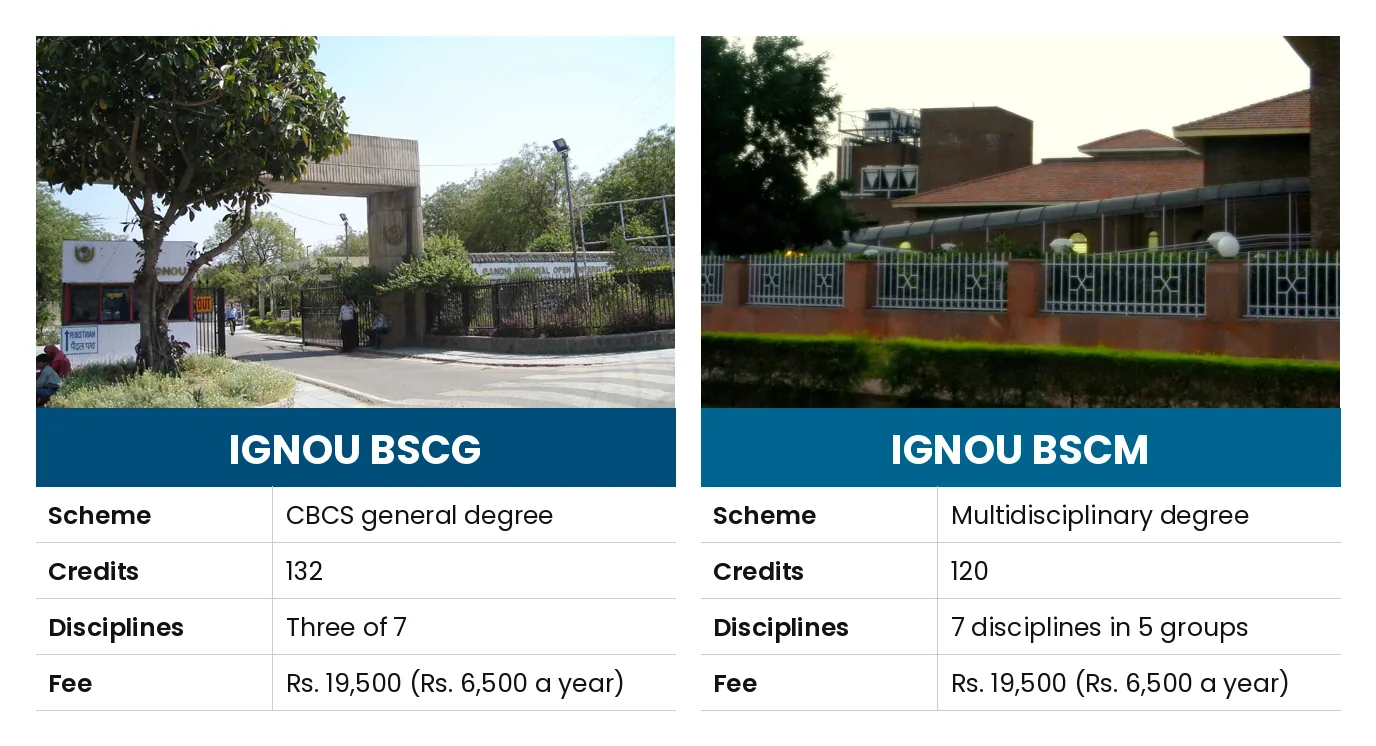
BSCG is a 3-year B.Sc. (General) programme under the UGC Choice Based Credit System, while BSCM is a 3-year multidisciplinary degree offered under NEP 2020 in line with the UGC Curriculum and Credit Framework. BSCG suits students seeking a general science degree, while BSCM is for those interested in a multidisciplinary approach aligned with NEP 2020.
IGNOU BSCG vs BSCM: what each one is and how they differ
IGNOU’s BSCG and BSCM programmes differ in their foundational frameworks. The Bachelor of Science (General) (BSCG) operates under the UGC Choice Based Credit System (CBCS). Its programme page states that it was developed as per UGC guidelines.
The Bachelor of Science (Multidisciplinary) (BSCM) is offered under the National Education Policy (NEP) 2020. This programme aligns with the UGC Curriculum and Credit Framework, specifically within the FYUP section. The programme guide describes BSCM as a 3-year programme under the UGC-FYUP scheme. Both programmes are offered by Indira Gandhi National Open University (IGNOU), New Delhi, through Open and Distance Learning (ODL) mode. IGNOU lists both BSCG and BSCM among its ODL programmes.
The BSCM is categorised as a 3-year multidisciplinary degree. It is listed under “Multidisciplinary Bachelor Degree Programmes (3-years)” and is managed by the School of Sciences (SOS). The BSCG programme does not publish details about its specific school or a multidisciplinary category in the provided facts. Both programmes state that they offer future prospects in higher education, promotion, and employment opportunities.
Eligibility for master’s degrees from IGNOU varies by programme. For example, a two-year Master of Commerce (MCOM) requires a Bachelor’s degree or higher from a recognised university. A one-year M.Com (MCOMOY) requires any four-year Bachelor’s degree with Honours or Honours with Research.
| Point | BSCG | BSCM |
|---|---|---|
| University offering the program | Indira Gandhi National Open University (IGNOU), New Delhi | Indira Gandhi National Open University (IGNOU), New Delhi |
| Program delivery mode | Open and Distance Learning (ODL); the programme is listed among the ODL programmes | Open and Distance Learning (ODL); the programme is listed among the ODL programmes |
| Two-year MCOM eligibility | MCOM (2 years) requires a Bachelor’s degree or a higher degree from a recognised university | MCOM (2 years) requires a Bachelor’s degree or a higher degree from a recognised university |
| Two-year MA eligibility | MA Political Science (2 years) requires a Bachelor’s degree or a higher degree (July 2026) | MA Political Science (2 years) requires a Bachelor’s degree or a higher degree (July 2026) |
| One-year MCOM eligibility | One-year M.Com (MCOMOY) requires any four-year Bachelor’s degree with Honours or Honours with Research | One-year M.Com (MCOMOY) requires any four-year Bachelor’s degree with Honours or Honours with Research |
| One-year MA eligibility | One-year MA English (MAEGOY) requires any four-year Bachelor’s degree with Honours or Honours with Research (July 2026) | One-year MA English (MAEGOY) requires any four-year Bachelor’s degree with Honours or Honours with Research (July 2026) |
| Program scheme | B.Sc. (General) under the UGC Choice Based Credit System | Offered under NEP 2020 in line with the UGC Curriculum and Credit Framework (FYUP section) |
| Program description | Developed under the Choice Based Credit System as per UGC guidelines | A 3-year programme under the UGC-FYUP scheme |
| Future career prospects | Higher education, promotion and employment opportunities | Higher education, promotion and employment opportunities |
BSCM only
- Program category: BSCM is listed under “Multidisciplinary Bachelor Degree Programmes (3-years)”
- School offering the program: School of Sciences (SOS)
IGNOU BSCG vs BSCM recognition and validity
Both the IGNOU BSCG and BSCM degrees hold similar recognition. Degrees, diplomas, and certificates awarded by IGNOU are recognised by all member institutions of the Association of Indian Universities (AIU).
The University Grants Commission (UGC) regulation, as quoted by IGNOU, states that undergraduate and postgraduate degrees and postgraduate diplomas obtained through Open and Distance Learning (ODL) or Online mode are equivalent to corresponding conventional-mode awards. IGNOU further states that its programmes, including BSCG and BSCM, are at par with programmes approved by the UGC-Distance Education Bureau.
A generic “Bachelor of Science” (ODL, UG) row for IGNOU appears on the UGC-DEB list for the 2026-27 July session. This applies to both BSCG and BSCM. The BSCM programme guide specifically states that the degree is recognised by all AIU member universities and is at par with degrees from all Indian universities. For the BSCG degree, students must achieve at least Grade D in each course to be eligible for the degree.
| Point | BSCG | BSCM |
|---|---|---|
| AIU recognition of awards | Degrees, diplomas and certificates awarded by IGNOU are recognised by all member institutions of the Association of Indian Universities | Degrees, diplomas and certificates awarded by IGNOU are recognised by all member institutions of the Association of Indian Universities |
| Equivalence with conventional degrees | UGC regulation quoted by IGNOU: UG/PG degrees and PG diplomas through ODL or Online mode are treated as equivalent to the corresponding conventional-mode awards | UGC regulation quoted by IGNOU: UG/PG degrees and PG diplomas through ODL or Online mode are treated as equivalent to the corresponding conventional-mode awards |
| Standing with UGC-DEB approved | IGNOU states its programmes are at par with programmes approved by the UGC-Distance Education Bureau | IGNOU states its programmes are at par with programmes approved by the UGC-Distance Education Bureau |
| UGC-DEB list entry | A plain “Bachelor of Science” (ODL, UG) row for IGNOU is on the UGC-DEB list for 2026-27, July session | A plain “Bachelor of Science” (ODL, UG) row for IGNOU is on the UGC-DEB list for 2026-27, July session |
BSCG only
- Degree eligibility criteria: At least Grade D in each course to be eligible for the B.Sc. degree
BSCM only
- General recognition statement: Recognised by all AIU member universities; at par with degrees of all Indian universities
- Award after three years: Six semesters / 120 credits = Undergraduate Degree with Major in the relevant discipline (general FYUP rule)
More on the IGNOU degree: whether an IGNOU degree is valid and IGNOU degree certificate, migration and convocation.
IGNOU BSCG vs BSCM courses offered
The IGNOU BSCG and BSCM programmes both offer a Bachelor of Science degree with a minimum duration of three years and a maximum of six years. Both programmes require 10+2 with science subjects or its equivalent for eligibility and are taught in English and Hindi.
Its course categories include Discipline Specific Core (DSC), Discipline Specific Electives (DSE), AECC, and SEC. Learners choose three disciplines from seven options, with DSC and DSE courses drawn only from these three. For Botany, Chemistry, Physics, and Zoology, a 6-credit course combines 4-credit theory and 2-credit lab components.
| Point | BSCG | BSCM |
|---|---|---|
| Credit definition | One credit = 30 hours of learner study | One credit = 30 hours of learner study |
| Minimum and maximum duration | Minimum 3 years, maximum 6 years Minimum 36 months, maximum 72 months |
Minimum 3 years, maximum 6 years Minimum 3 years, maximum 6 years 3 years (July 2026) |
| Re-admission beyond maximum duration | Two more years through re-admission to unfinished courses (Programme Guide 2020) | If not completed in 6 years: fresh admission, then credit transfer for courses already passed |
| Total credits | 132 credits, 22 per semester over six semesters | 120 credits in a minimum of six semesters (three years) |
| Credit split | DSC 72 + DSE 36 + AECC 8 + SEC 16 = 132 credits; semesters 1-4 DSC, semesters 5-6 DSE | 72 credits: 24 credits from each of the three disciplines Three 4-credit vocational courses = 12 credits Two 4-credit courses = 8 credits, semesters 2 and 3 Four 4-credit courses = 16 credits One 6-credit course outside the three chosen disciplines One 6-credit course, first semester only |
| Disciplines list | Botany, Chemistry, Geography, Geology, Mathematics, Physics, Zoology | 7: Botany, Chemistry, Geography, Geology, Mathematics, Physics, Zoology |
BSCG only
- Course categories: Discipline Specific Core (DSC), Discipline Specific Electives (DSE), AECC, SEC
- Number of disciplines: Three of seven: Botany, Chemistry, Geography, Geology, Mathematics, Physics, Zoology; DSC and DSE from those three only
- Lab structure: Botany, Chemistry, Physics, Zoology: 6-credit course = 4-credit theory + 2-credit lab, taken together
- Mathematics courses: Single 6-credit courses including 1 credit of tutorials
- AECC courses: Environmental Science and English/MIL Communication
- Eligibility: 10+2 with science subjects or its equivalent
- Medium of instruction: English and Hindi; material in both
BSCM only
- Multiple Entry Exit Scheme: Introduced for IGNOU UG programmes under the FYUP framework from the July 2025 admission cycle; Exit points after the first and second year
- Exit certificate diploma: Certificate or diploma on exit is awarded on demand; an extra 4-credit vocational course is taken through CRCS; To exit after year 1 (UG Certificate) or year 2 (UG Diploma) a learner completes an extra 4-credit vocational course: 40+4 or 80+4 credits
- Credits per semester per year: 18 credits in semester 1, 22 in semester 2, 20 in semesters 3-6; 40 per year
What BSCG offers
| Programme | Level | Fee | Eligibility |
|---|---|---|---|
| Bachelor of Science (General) | UG | Rs. 6,500 per year (programme page; Notification 103 row “BSCM/BSCG”) (July 2026 / January 2027 fee notification; no fresh-admission listing found) | 10+2 with science subjects or its equivalent |
What BSCM offers
| Programme | Level | Fee | Eligibility |
|---|---|---|---|
| Bachelor of Science (Multidisciplinary) | UG | Rs. 6,500 per year (July 2026 (same fee notified for January 2027)) | 10+2 with science subjects or its equivalent |
IGNOU course guides: IGNOU BA; IGNOU MBA; IGNOU MA; IGNOU MCA and IGNOU syllabus.
IGNOU student services
IGNOU BSCG vs BSCM fees, course by course
The IGNOU BSCG and BSCM programmes both charge an annual fee of Rs. 6,500 for the July 2026 and January 2027 admission cycles. This fee is consistent across both programmes, as published in the fee notification. Both are undergraduate degrees with a minimum duration of three years.
For the BSCG programme, the total fee is Rs. 19,500, calculated as Rs. 6,500 per year for three years. Plus this, a University Development fee of Rs. 400 is payable at admission for the July 2026 session. The programme page on ignou.ac.in also lists the fee as Rs. 6,500 per year.
The prospectus for July 2026 confirms this annual fee. Like BSCG, a University Development fee of Rs. 400 is payable at admission for the July 2026 session, along with an additional registration fee of Rs. 300. Both programmes require 10+2 with science subjects or equivalent for eligibility and are offered in English and Hindi mediums.
| Point | BSCG | BSCM |
|---|---|---|
| University Development fee | Rs. 400, paid at admission in addition to the programme fee (July 2026) | Rs. 400, paid at admission in addition to the programme fee (July 2026) |
| Programme fee notification | Rs. 6,500 (revised from Rs. 6,300), shared row “BSCM /BSCG”, July 2026 and January 2027 cycles | Rs. 6,500 (revised from Rs. 6,300), shared row “BSCM /BSCG”, July 2026 and January 2027 cycles |
| Programme fee ignou.ac.in | Rs. 6,500 per year | Rs. 6,500 per year |
BSCG only
- Historical programme fee: Rs. 4,500 per year; guide prints Rs. 12,600 for the full programme; Rs. 200 registration in year 1 (Programme Guide 2020 (superseded))
BSCM only
- Programme fee prospectus: Rs. 6,500 per year (July 2026)
What BSCG offers
| Programme | Level | Fee | Eligibility |
|---|---|---|---|
| Bachelor of Science (General) | UG | Rs. 6,500 per year (programme page; Notification 103 row “BSCM/BSCG”) (July 2026 / January 2027 fee notification; no fresh-admission listing found) | 10+2 with science subjects or its equivalent |
What BSCM offers
| Programme | Level | Fee | Eligibility |
|---|---|---|---|
| Bachelor of Science (Multidisciplinary) | UG | Rs. 6,500 per year (July 2026 (same fee notified for January 2027)) | 10+2 with science subjects or its equivalent |
IGNOU fees in full: IGNOU fee structure.
IGNOU BSCG vs BSCM admission: sessions, last dates and portals
Both IGNOU BSCG and BSCM programmes follow two admission cycles annually, in January and July. As of 27 October 2026, the admission portal shows the July 2026 ODL cycle, and registration for this cycle is over. The dates for the January 2027 cycle are not yet published for either programme.
A non-refundable registration fee of Rs. 300 is payable at admission for both BSCG and BSCM, in addition to the programme fee. IGNOU states that students may pursue two academic programmes simultaneously through ODL or Online mode, with conditions applying to both BSCG and BSCM. BSCM allows re-entry to the second year for UG Certificate holders and to the third year for UG Diploma holders from the same programme, provided entry is within 7 years of the UG Certificate award. This re-entry provision is not stated for BSCG. For FYUP bachelor programmes like BSCM, a change of course is permitted only in the first year. The BSCG programme code is included in the December 2026 term-end examination date sheet, indicating it is still examined for continuing learners. BSCM is listed on the ODL admission portal for July 2026.
| Point | BSCG | BSCM |
|---|---|---|
| Registration fee | Rs. 300, non-refundable, paid at admission in addition to the programme fee (July 2026) | Rs. 300, non-refundable, paid at admission in addition to the programme fee (July 2026) |
| Admission cycles | Two admission cycles a year: January and July (July 2026) | Two admission cycles a year: January and July (July 2026) |
| Current admission portal status | Portal shows the July 2026 ODL cycle and says registration for July 2026 is over; January 2027 dates not shown | Portal shows the July 2026 ODL cycle and says registration for July 2026 is over; January 2027 dates not shown |
| Simultaneous programmes | A student may pursue two academic programmes simultaneously through ODL / Online mode (conditions apply) (July 2026) | A student may pursue two academic programmes simultaneously through ODL / Online mode (conditions apply) (July 2026) |
BSCG only
- Examined for continuing learners: Code BSCG is in the programme-code list of the December 2026 term-end examination date sheet (December 2026 TEE)
BSCM only
- Re-entry after exit: Re-entry allowed in Major as well as Multidisciplinary programmes: UG Certificate holders enter year 2, UG Diploma holders enter year 3 of the same programme (July 2025 onward)
- Re-entry with UG Certificate: IGNOU UG Certificate holders get entry to the second year of the same programme (July 2025 onward)
- UG Certificate entry window: Entry to an IGNOU programme within 7 years of award of the UG Certificate (July 2025 onward)
- Listed on admission portal: BSCM is listed on the ODL admission portal (July 2026)
- Change of course: For FYUP bachelor programmes, change of course only in the first year (Programme Guide 2025)
IGNOU admission this session: IGNOU admission 2026; how to apply to IGNOU online; IGNOU admission last date and IGNOU admission status.
IGNOU BSCG vs BSCM study material, classes and study centres
BSCG and BSCM both provide printed self-instructional study material to students. Learners can also opt for a soft copy of the study material instead of printed books. This choice comes with a 15% discount on the programme fee for both the BSCG and BSCM programmes.
IGNOU states that both programmes offer self-learning material in print book and/or e-book format.
| Point | BSCG | BSCM |
|---|---|---|
| Self-learning material format | Printed self-instructional study material is provided (print book and/or e-book) | Printed self-instructional study material is provided (print book and/or e-book) |
| Soft-copy discount | 15% discount on the programme fee for learners who opt for soft copy instead of printed material | 15% discount on the programme fee for learners who opt for soft copy instead of printed material |
IGNOU books and centres: IGNOU study material and IGNOU regional and study centres.
IGNOU BSCG vs BSCM assignments and exams
Both the BSCG and BSCM programmes require assignments to be submitted before students can take the term-end examinations. For the July 2026 session, assignment responses are compulsory for both degrees. IGNOU publishes numerical marks and division (I, II or Pass) on request for both programmes.
Term-end examinations for both BSCG and BSCM are held twice a year, typically in June and December, for the July 2026 session. Theory courses in both programmes carry a weightage of 30% for assignments and 70% for the term-end exam. This applies to the Programme Guide 2020 for BSCG and the Programme Guide 2025 for BSCM.
A minimum of Grade D (35%) is required to pass assignments and the term-end exam in both programmes. BSCM has a credit cap of 48 credits for any single term-end examination, a detail not published for BSCG.
Laboratory attendance is compulsory for both BSCG and BSCM. Each 2-credit lab course in BSCG requires one continuous week at the study centre. BSCM states a similar requirement of one continuous week, approximately 60 hours, at the study centre for each 2-credit lab course. For laboratory evaluation, both programmes allocate 70% to experiments. BSCG allocates 30% to unguided experiments, while BSCM allocates 30% to an unguided end-of-course test. BSCM states that re-evaluation is not allowed for projects, practicals, or assignments, a policy not published for BSCG.
| Point | BSCG | BSCM |
|---|---|---|
| Assignments compulsory | Assignment responses must be submitted before taking the term-end examinations (July 2026) | Assignment responses must be submitted before taking the term-end examinations (July 2026) |
| Term-end exam sessions | Twice a year, ordinarily June and December (July 2026) | Twice a year, ordinarily June and December (July 2026) |
| Numerical marks and division | On request the University provides numerical marks and division (I, II or Pass) (July 2026) | On request the University provides numerical marks and division (I, II or Pass) (July 2026) |
| Assignment term-end weightage | Theory: 30% assignments, 70% term-end exam (Programme Guide 2020) | Theory courses: 30% assignments, 70% term-end exam (Programme Guide 2025) |
| Pass marks | At least Grade D (35%) in assignments and term-end exam (Programme Guide 2020) | At least Grade D (35%) in assignments and in the term-end exam, and overall in each course (Programme Guide 2025) |
| Laboratory attendance | Compulsory (Programme Guide 2020) | Attendance in laboratory courses is compulsory (Programme Guide 2025) |
| Laboratory time | Each 2-credit lab course: one continuous week at the study centre (Programme Guide 2020) | Each 2-credit lab course needs one continuous week (about 60 hours) at the study centre (Programme Guide 2025) |
| Laboratory evaluation | Experiments 70%, unguided experiments 30% (Programme Guide 2020) | Experiments 70%; unguided end-of-course test 30% (Programme Guide 2025) |
BSCG only
BSCM only
IGNOU exam cycle: IGNOU assignments; IGNOU date sheet; IGNOU hall ticket and IGNOU result and grade card.
IGNOU BSCG vs BSCM credit transfer, migration and re-admission
IGNOU publishes that a student of another university can be admitted to complete an equivalent programme based on credits already earned for both BSCG and BSCM. This means that a student from another university can transfer credits to either programme.
For BSCM, lateral entry from another institution is possible only if the Major and Minor disciplines match those offered by IGNOU. If the disciplines do not match, admission to year 1 is required, followed by a credit transfer process.
BSCM only
- Lateral entry from another institution: Entry from another institution only if Major and Minor disciplines match those offered by IGNOU; otherwise admission to year 1 and credit transfer
For enrolled IGNOU students: IGNOU re-registration.
IGNOU BSCG or BSCM: which is better for you
Students seeking a degree with multiple exit points should choose the IGNOU BSCM programme. It offers exit options after the first year for an Undergraduate Certificate and after the second year for an Undergraduate Diploma. Both programmes require 10+2 with science subjects or equivalent for eligibility.
For those planning postgraduate studies, the BSCG and BSCM programmes both lead to a Bachelor’s degree, which is required for a two-year Master of Commerce (MCOM) or Master of Arts (MA) degree. However, a one-year Master’s degree, such as the MCOMOY or MAEGOY, requires any four-year Bachelor’s degree with Honours or Honours with Research.
Students prioritising a specific admission cycle should note that the July 2026 ODL cycle registration for both BSCG and BSCM is over. Information for the January 2027 cycle is not yet shown on the admission portal. Both programmes have two admission cycles per year, in January and July.
Learners interested in a multidisciplinary approach will find the BSCM programme more suitable. It is offered under NEP 2020 with a multidisciplinary structure, allowing students to choose three disciplines from five groups. The BSCG programme, under the UGC Choice Based Credit System, focuses on three chosen disciplines from a list of seven, with DSC and DSE courses drawn only from those three.
The annual programme fee for both BSCG and BSCM is Rs. 6,500 for the July 2026 and January 2027 cycles. Both also require a non-refundable registration fee of Rs. 300 and a University Development fee of Rs. 400 at admission.
Notices and Documents from IGNOU
- Programme Guide Bscg 2020
- BSCM Common Prospectus July 2026
- IGNOU Tentative Date Sheet December 2026 Term End Examination
- IGNOU Notification 103 Revised Programme Fees 2026
- Programme Page BSCG
- BSCM Samarth Portal Admission Home
- BSCM Ugc Deb IGNOU Bachelor Rows
- BSCG Assignments Bachelor Page
- Programme Guide Bscm 2025
- IGNOU Four Year Undergraduate Programme MEME Scheme July 2025
- Programme Page BSCM
- BSCM Samarth Portal Programmes List
Common IGNOU Questions
Which IGNOU Bachelor of Science programme, BSCG or BSCM, is better suited for a student seeking a general science degree?
BSCG is designed as a B.Sc. (General) under the UGC Choice Based Credit System, offering a broad science education. BSCM is a multidisciplinary degree offered under NEP 2020, aligning with the UGC Curriculum and Credit Framework. A student seeking a general science degree without a specific specialisation might find BSCG more traditional, while BSCM offers a more flexible, modern approach.
What is the difference in the annual programme fees for BSCG and BSCM at IGNOU?
Both BSCG and BSCM have an annual programme fee of Rs. 6,500. This fee was revised from Rs. 6,300 for the July 2026 and January 2027 admission cycles. Plus the programme fee, a non-refundable registration fee of Rs. 300 and a University Development fee of Rs. 400 are paid at admission for both programmes.
Are degrees awarded for IGNOU BSCG and BSCM recognised by other Indian universities?
Yes, degrees awarded for both BSCG and BSCM are recognised by all member institutions of the Association of Indian Universities (AIU). IGNOU also states that its ODL programmes, including these B.Sc. degrees, are treated as equivalent to conventional-mode awards by the UGC. This ensures the degrees hold value across India for higher education and employment.
What are the eligibility criteria for admission to the BSCG and BSCM programmes at IGNOU?
For both BSCG and BSCM, the eligibility criterion is 10+2 with science subjects or its equivalent. This means students must have a science background at the intermediate level to apply for either of these Bachelor of Science programmes.
When are the admission cycles for the BSCG and BSCM programmes at IGNOU?
Both BSCG and BSCM have two admission cycles per year, in January and July. The admission portal currently shows that registration for the July 2026 ODL cycle is over. Dates for the January 2027 cycle are not yet published.
How do the study materials and classes differ between IGNOU BSCG and BSCM?
For both BSCG and BSCM, printed self-instructional study material is provided, with an option for a 15% discount if the learner chooses soft copies.
What are the requirements for assignments and term-end examinations in BSCG and BSCM?
For both BSCG and BSCM, assignments are compulsory and must be submitted before taking the term-end examinations. Term-end examinations are held twice a year, typically in June and December. For theory courses in both programmes, assignments contribute 30% and the term-end exam contributes 70% to the final grade.
Where are the term-end examinations held for students enrolled in IGNOU’s BSCG and BSCM?
However, IGNOU conducts term-end examinations twice a year, usually in June and December, at designated examination centres. Students typically select their preferred examination centre during the application process.
In which languages are the study materials and instruction provided for the BSCG and BSCM programmes?
For both BSCG and BSCM, the medium of instruction and study materials are available in both English and Hindi. This allows students to choose the language that best suits their learning preference.
Can a student change their chosen disciplines or combine two programmes simultaneously with BSCG or BSCM?
A student may pursue two academic programmes simultaneously through ODL or Online mode, which applies to both BSCG and BSCM. For BSCM, a change of course is only allowed in the first year. The facts do not state specific rules for changing disciplines in BSCG.
How many credits are required to complete the IGNOU BSCG and BSCM degrees?
The BSCG programme requires a total of 132 credits, with 22 credits per semester over six semesters. The BSCM programme requires 120 credits in a minimum of six semesters, with 18 credits in semester 1, 22 in semester 2, and 20 in semesters 3-6. Both programmes have a minimum duration of 3 years and a maximum of 6 years.
What is the structure of laboratory courses for BSCG and BSCM, and are they compulsory?
For both BSCG and BSCM, laboratory attendance is compulsory. In BSCG, Botany, Chemistry, Physics, and Zoology courses have a 6-credit structure of 4-credit theory and 2-credit lab, taken together. BSCM has a similar structure for Botany, Chemistry, Geology, Physics, and Zoology, where each 6-credit course includes a 4-credit theory and a 2-credit laboratory component.